home | information | publications| questions | opposition | contact us | discuss | facebook
books containing:
openness theology proper | openness perspectives
books containing opposing views
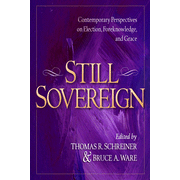
Still Sovereign
Scripture says that God is sovereign over all things, yet we have free will to determine our actions. So to what extent is God supreme? In this masterful examination of the sovereignty of God, 13 respected scholars help you understand the full authority of the Lord---and explain how to apply this knowledge to your life. Previously published as two volumes: The Grace of God and The Bondage of the Will. 368 pages, softcover from Baker.
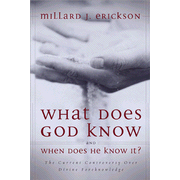
What Does God Know and When Does He Know It?
As "openness theology" becomes increasingly controversial within evangelicalism today, divine foreknowledge threatens to join predestination vs. free will among Christianity's divisively debated doctrines. Now one of America's most respected theologians examines the question from both sides. Thoroughly evaluating all relevant arguments with graceful deliberation, Erickson offers thoughtful conclusions with less heat and more light. 304 pages, hardcover from Zondervan.
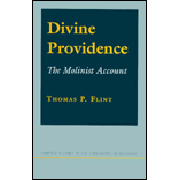
Divine Providence: The Molinist Account
This book available at Barnes & Noble.com by clicking here.
Thomas P. Flint develops and defends the idea of divine providence sketched by Luis de Molina, the sixteenth-century Jesuit theologian. The Molinist account of divine providence reconciles two claims long thought to be incompatible: that God is the all-knowing governor of the universe and that individual freedom can prevail only in a universe free of absolute determinism. The Molinist concept of middle knowledge holds that God knows, though he has no control over, truths about how any individual would freely choose to act in any situation, even if the person never encounters that situation. Given such knowledge, God can be truly providential while leaving his creatures genuinely free. Divine Providence is by far the most detailed and extensive presentation of the Molinist view ever written.
Middle knowledge is hotly debated in philosophical theology, and the controversy spills over into metaphysics and moral philosophy as well. Flint ably defends the concept against its most influential contemporary critics, and shows its importance to Christian practice. With particular originality and sophistication, he applies Molinism to such aspects of providence as prayer, prophecy, and the notion of papal infallibility, teasing out the full range of implications for traditional Christianity.
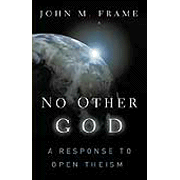
No Other God: A Response to Open Theism
The theological movement known as open theism is shaking the church today, challenging the Reformed doctrines of God's sovereignty, foreknowledge, and providence. In this timely work, John M. Frame clearly describes open theism and evaluates it biblically. He addresses questions such as: How do open theists read the Bible? Is love God's most important attribute? Is God's will the ultimate explanation of everything? Do we have genuine freedom? Is God ever weak or changeable? Does God know everything in advance? Frame not only answers the objections of open theists but sharpens our understanding of the relationship between God's eternal plan and the decisions or events of our lives.
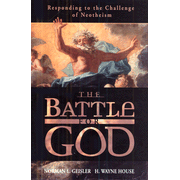
The Battle for God
Listen and learn as Geisler and House go head-to-head with Boyd, Pinnock, and other neotheists. Defending the historical evangelical view of God, the authors take issue with the theology, hermeneutics, and philosophy of neotheism---especially the question of God's knowledge and control of past and future events. A well-argued defense of God as Creator and Sustainer. 256 pages, softcover from Kregel.
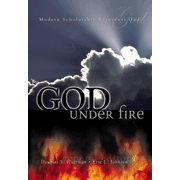
God Under Fire: Modern Scholarship Reinvents God
(PUBZondervan)The classical view of God has come under attack, particularly in the area of his ongoing relationship with creation. Controversies have been generated by pantheists, radical feminists, and open theists. These 12 essays staunchly defend the traditional understanding, outlining serious implications for us if we deviate from it. 256 pages, hardcover.
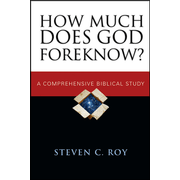
How Much Does God Foreknow? A Comprehensive Biblical Study
Does the Bible teach that God's foreknowledge is exhaustive and infallible?
Does Scripture affirm that God foreknows the free decisions of human beings?
Current debates over the extent of God's foreknowledge, argues Steven C. Roy, have not given sufficient consideration to the complete biblical revelation. Seeking to correct this imbalance, Roy provides in-depth studies of dozens of key passages in both the Old and the New Testaments.
Cognizant of the current debates between classical notions of divine foreknowledge and more recent "openness" views, Roy interacts incisively with their respective theological positions and draws out implications of biblical teaching for the practical matters of Christian worship, prayer, guidance, suffering and evil, and ultimate hope in the triumph of God.
Steven C. Roy (Ph.D., Systematic Theology, Trinity Evangelical Divinity School) is Associate Professor of Pastoral Theology at Trinity Evangelical Divinity School in Deerfield, Illinois. He has also taught systematic theology, historical theology and ethics. Prior to coming to Trinity, he was a pastor for twelve years and taught in Cameroon, West Africa. He is author of God as Omnicompetent Responder? Questions about the Grounds of Eschatological Confidence in Open Theism in Looking to the Future, edited David W. Baker.
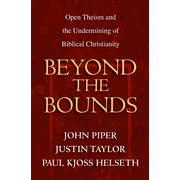
Beyond the Bounds
Isaiah tells us that knowing the future distinguishes God from idols. In denying exhaustive foreknowledge, "open theism" undermines the foundation of orthodox Christianity. Explaining why this new theology's god is not the God of Scripture, 12 pastors and teachers provide a philosophical, historical, and linguistic understanding of the boundary lines at stake. 288 pages, softcover from Crossway Books.
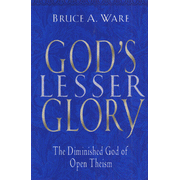
God's Lesser Glory
Christians throughout history have been strengthened by their confidence that God knows everything about the future. But consider this: What if it simply is not true? What if God can only rely on His best guess about tomorrow--just as you and I do? Would it not affect your trust in Him, your confidence in facing the future, your worship, and your motivation to leave everything in His hands? And yet this is the consequence that has to be faced if you trust what a number of leading voices in evangelicalism are proposing under the doctrine of open theism. In its redefinition of the nature of divine providence, open theism adjusts the entire picture of God's sovereignty and involvement in our lives. Bruce Ware carefully summarizes and critiques this dangerous doctrine from a thoroughly biblical perspective, providing an excellent treatment of both the classical and openness views. He explores their implications and faithfully pinpoints the subtle ways that open theism undermines our trust in God and lessens His glory in our lives.
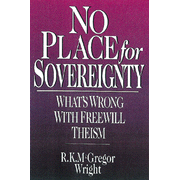
No Place for Sovereignty
Many evangelical thinkers are calling into question the sovereignty of God, a theory called "freewill theism." Wright examines that theory, showing what is wrong with it biblically, theologically, and philosophically. Along the way, he looks at historical theology and makes a strong case for the Reformed view of God's sovereignty. 264 pages, softcover from InterVarsity.
opentheism.info search powered by Google
site created and maintained by: © 2005-2009 yxboom c/o theologyweb.com
image credit: The Thinker by Vit Kovalcik
valid xhtml strict 1.0! | made with css | spam poison
 - "I'm geebob and I approve this website".